
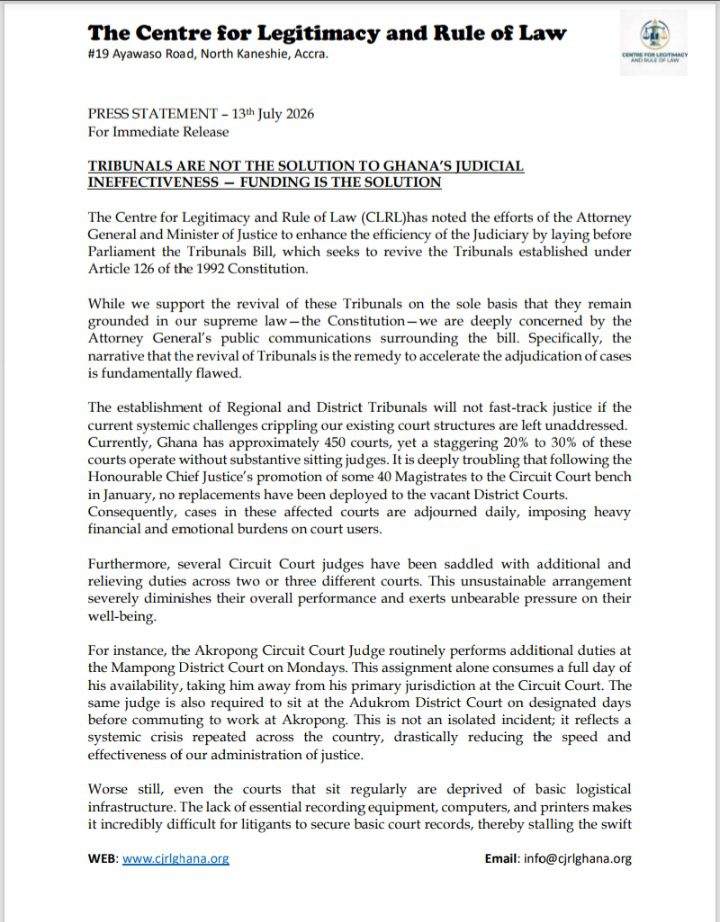
The Centre for Legitimacy and Rule of Law (CLRL) has warned that the government’s plan to revive Regional and District Tribunals will not solve the chronic inefficiencies in Ghana’s administration of justice unless systemic funding deficits are urgently addressed.
In a press statement, the policy think-tank reacted to the introduction of the Tribunals Bill in Parliament by the Attorney General and Minister of Justice, which seeks to reactivate the tribunal structures established under Article 126 of the 1992 Constitution.
While the CLRL noted that it supports the revival solely because it aligns with the supreme law of the land, it described the Attorney General’s narrative—that tribunals are the definitive remedy to fast-track case adjudications—as “fundamentally flawed”.
According to the group, creating new judicial structures is an exercises in futility when between 20% and 30% of Ghana’s existing 450 courts are currently operating without substantive sitting judges.
The CLRL referenced a widening vacancy gap created after the Chief Justice promoted 40 Magistrates to the Circuit Court bench in January without deploying replacements to the affected District Courts.
This deficit, the group noted, has forced several Circuit Court judges to take on unsustainable, relieving duties across two or three different courts, drastically diminishing their performance and well-being.
Detailing the severity of the crisis, the statement pointed out that the Akropong Circuit Court Judge is routinely required to manage additional duties at the Mampong District Court on Mondays and sit at the Adukrom District Court on designated days before commuting back to his primary station.
The CLRL maintained that this is not an isolated incident but a reflection of a nationwide systemic crisis that imposes severe emotional and financial burdens on court users.
Beyond human resource constraints, the think-tank painted a bleak picture of the logistical deficit plaguing operational courts, citing a severe lack of computers, printers, recording equipment, and functional photocopy machines.
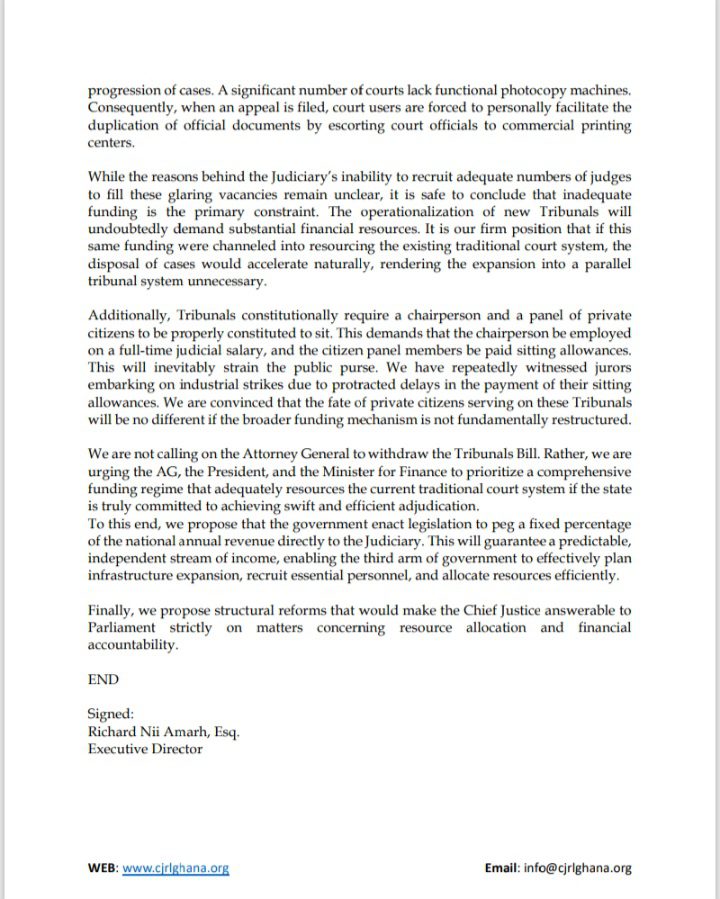
The group revealed that when appeals are filed, litigants are routinely forced to personally escort court officials to commercial printing centres to duplicate official documents.
The CLRL argued that inadequate funding remains the primary constraint behind the Judiciary’s inability to recruit sufficient personnel.
It further cautioned that operationalising the new tribunal system will heavily strain the public purse, as it constitutionally demands full-time judicial salaries for chairpersons and sitting allowances for panels of private citizens.
Pointing to previous industrial strikes by jurors over delayed allowances, the group warned that private citizens serving on the new tribunals will likely face the same fate.
Rather than demanding a withdrawal of the Tribunals Bill, the CLRL urged the Attorney General, the President, and the Minister for Finance to prioritise a comprehensive funding regime for the traditional court system.
“It is our firm position that if this same funding were channeled into resourcing the existing traditional court system, the disposal of cases would accelerate naturally, rendering the expansion into a parallel tribunal system unnecessary,” the statement signed by Executive Director Richard Nii Amarh, Esq., noted.
To secure a sustainable future for the third arm of government, the CLRL proposed that the state enact legislation to peg a fixed percentage of national annual revenue directly to the Judiciary to ensure a predictable and independent stream of income.
Additionally, the group recommended structural reforms that would make the Chief Justice strictly answerable to Parliament on matters concerning resource allocation and financial accountability.
By: Rainbowradioonline.com/Ghana