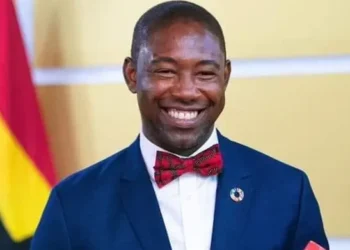
Private legal practitioner and Executive Director of the Centre for Legitimacy and Rule of Law, Richard Nii Armah, has underlined the need for the Attorney-General and Minister for Justice to intensify all extradition processes for former Finance Minister, Ken Ofori-Atta.
He noted that extradition processes involve the Attorney-General’s Departments of the countries involved.
In the case of Ken Ofori-Atta, he explained that the Attorney-General of Ghana would have to work in collaboration with the Attorney-General of the United States.
He said the Special Prosecutor has no locus in law to lead the extradition processes of Ken Ofori-Atta unless the Attorney-General decides to authorise him to do so.
Speaking in an interview on Nyankonton Mu Nsem on Rainbow Radio 87.5FM, he stated that extradition processes are a daunting task.
He noted that countries applying for the extradition of suspected criminals struggle through the procedures, citing the WikiLeaks saga involving Julian Assange.
He recalled that the suspect ran and hid in Switzerland, taking almost 12 years before he was extradited, even under agreed terms.
Richard Nii Armah was responding to the outcome of a court case in which a US judge refused to side with the case presented by the Office of the Special Prosecutor (OSP).
A United States Immigration Court granted an application for adjustment of status submitted by Ghana’s former Minister for Finance, Ken Ofori-Atta, ruling that criminal allegations levelled against him by the OSP lack credible evidence and are politically motivated.
Delivering the decision following a hearing on June 15, 2026, United States Immigration Judge David Gardey affirmed that Mr Ofori-Atta established that he did not engage in criminal wrongdoing or personally profit during his tenure as Finance Minister.
Addressing the respondent’s immigration status, Judge Gardey noted that while Mr Ofori-Atta had overstayed his visa, he was actively pursuing status regularisation in good faith through an I-130 petition filed by his son, a US citizen.
Additionally, the ruling cited Interpol’s decision in February 2026 to delete a Red Notice previously issued against Mr Ofori-Atta after determining that the charges were predominantly political.
The judge further observed that the US Department of Justice had taken no action on an extradition request from Ghana, reinforcing the finding that the allegations lacked credibility.
The court accepted testimony indicating that the criminal proceedings were driven by political animosities between parties following the change of government.
Commenting on this, the lawyer explained that no court in the world thrives on hearsay and that no documentary evidence shows the former minister had been served.
He added that there are specific procedures involved when serving suspects outside the jurisdiction.
“There are processes involved when serving suspects who are under prosecution and outside the jurisdiction, which I hear the Attorney-General is working on. As to whether the processes are complete and Ofori-Atta has been served is not something done. So the Attorney-General must expedite any processes required in having Ofori-Atta extradited. At this point in time that Ofori-Atta has not been served, no judge will side with the OSP.”
The lawyer maintained that nothing has changed despite the outcome of the US case, adding, “even if it were a US citizen we were pursuing, it would have gone through the same process. It is not an easy process. It can take years. Whether Ofori-Atta has a residence permit or not, extradition is already a difficult task, and now he has gotten a permit. However, I will encourage the Attorney-General to be serious about this extradition of Ken Ofori-Atta.
One singular truth Ghanaians should be aware of is that the OSP has no legal authority to pursue extradition processes. Extradition is government to government. So the Attorney-General of the USA will deal with the Attorney-General of Ghana. So when going to court in the USA for the extradition processes, I don’t think the OSP will represent Ghana without authorisation from the Attorney-General’s Department.”
He concluded that the residence permit granted to Ofori-Atta has nothing to do with any extradition processes and that the judge who granted the permanent residency had no proof before the court to show that there was any strong reason to deny him permanent stay.
By: Rainbowradioonline.com/Ghana