
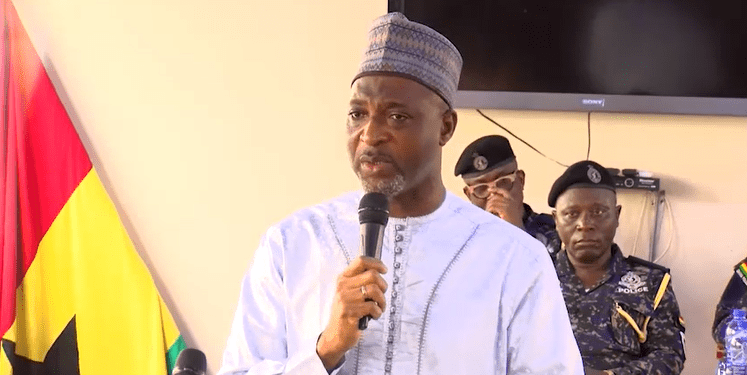
Government is contemplating introducing mandatory drug screening for individuals seeking employment within the public sector, Interior Minister Mohammed Mubarak Muntaka has disclosed.
He revealed that the Ministry of the Interior is currently preparing a Cabinet Information Paper on the initiative, which aims to prevent individuals struggling with substance abuse from entering the public service.
“Very soon, the Ministry of the Interior will be taking an Information Paper to Cabinet, and one of the things that we are going to do is to ensure that nobody gets into public service until we do a drug test on you,” he said.
Mr Muntaka made these observations during the commissioning of a newly built six-unit first-floor classroom block at Sakafiya Islamic Senior High School.
He explained that the policy proposal stems from observations made during this year’s security agencies recruitment drive, where over 100,000 applicants underwent medical evaluation, including psychiatric and drug tests.
According to the Minister, more than 6,000 candidates were turned down following the comprehensive screening, with over 4,000 testing positive for illicit substances and around 2,000 rejected on mental health grounds.
“It is shocking for us this year’s recruitment exercise. When we decided to test for drugs, over 6,000 people were disqualified because they tested positive for one drug or the other,” he said.
“If we hadn’t done this, many of them would have gotten through into the civil service,” he added.
Mr Muntaka noted that the outcome underscored the urgent necessity for the state to firm up measures aimed at tackling substance abuse among prospective public servants.
He acknowledged, however, that drug dependency is not restricted to new applicants, pointing out that some serving security personnel are equally battling substance-related challenges.
“Some of the officers that we have in the service, some already are into drugs. And we are taking steps to help them to get out of it,” he said.
He maintained that government cannot knowingly enlist and train individuals who are actively abusing drugs.
“We are not going to be allowing new people to be trained when we know you are already on drugs,” Mr Muntaka stated.
The Interior Minister further raised alarm over the growing infiltration of illicit drugs into senior high schools.
He alleged that a section of students has resorted to peddling tramadol and other dangerous substances to their peers, charging school administrators to monitor student activities more closely to curtail exposure to narcotics.
“Today, in some of our secondary schools, some of the students themselves are hiding to sell tramadol and other harmful drugs to their colleagues,” he said.
Mr Muntaka cautioned students against yielding to peer pressure and the false belief that substances such as cannabis and tramadol can enhance academic outputs.
“Drugs destroy you forever,” he cautioned.
“What is the use of that exam if by the time you get A-AAAA, you have destroyed yourself?” he asked.
He exhorted students navigating financial hardship and social challenges not to lose heart or turn to narcotics.
“Your future is way ahead of you. Your future is much brighter ahead of you,” he said.
Drawing from his personal life story, Mr Muntaka encouraged the students to stay devoted to their studies regardless of their economic backgrounds.
He recounted his humble beginnings as the son of a porridge seller, recalling how he hawked bananas, groundnuts, and mangoes across the streets of Kumasi to support his mother.
“I am a ‘kooko’ [porridge] seller’s son. My mother was selling ‘kooko’ in our home,” he said.
He noted that it never crossed his mind that he would one day serve as a Member of Parliament.
“If somebody had told me 40 years ago that one day I could even become a Member of Parliament, I would never have believed it,” he said.
Comparing his educational background to that of his eldest son, who gained admission into medical school at age 17, he highlighted the transformation hard work brings.
“My first son started medical school when he was 17 years old. And the day he entered [university] to start his medicine, I told him, ‘Eman, you are very lucky. You are starting medicine at 17. At 17 years old, I was still in primary school,’” he recalled.
Mr Muntaka urged the youth not to permit poverty or domestic duties to cloud their vision of a successful future.
“Don’t let the challenge of today—because your mother is poor, because when you go home, you have to help your parents to do one thing or the other—you think that hope is lost. No. There cannot be lost hope,” he said.
The newly commissioned structure features six classrooms, an administrative office, and a six-seater water closet facility.
The project is designed to offer both teachers and learners an improved atmosphere for academic work.
Mr Muntaka reiterated that continuous capital investments in educational infrastructure are targeted at grooming young people into patriotic citizens capable of contributing meaningfully to national growth.
“Students, all these things that we are doing, all this investment that we are putting in, it is for you to be better citizens than us,” he said.
He charged the students to maximize the facility and keep their eyes fixed on building a bright future for themselves and the nation.
By: Rainbowradioonline.com/Ghana