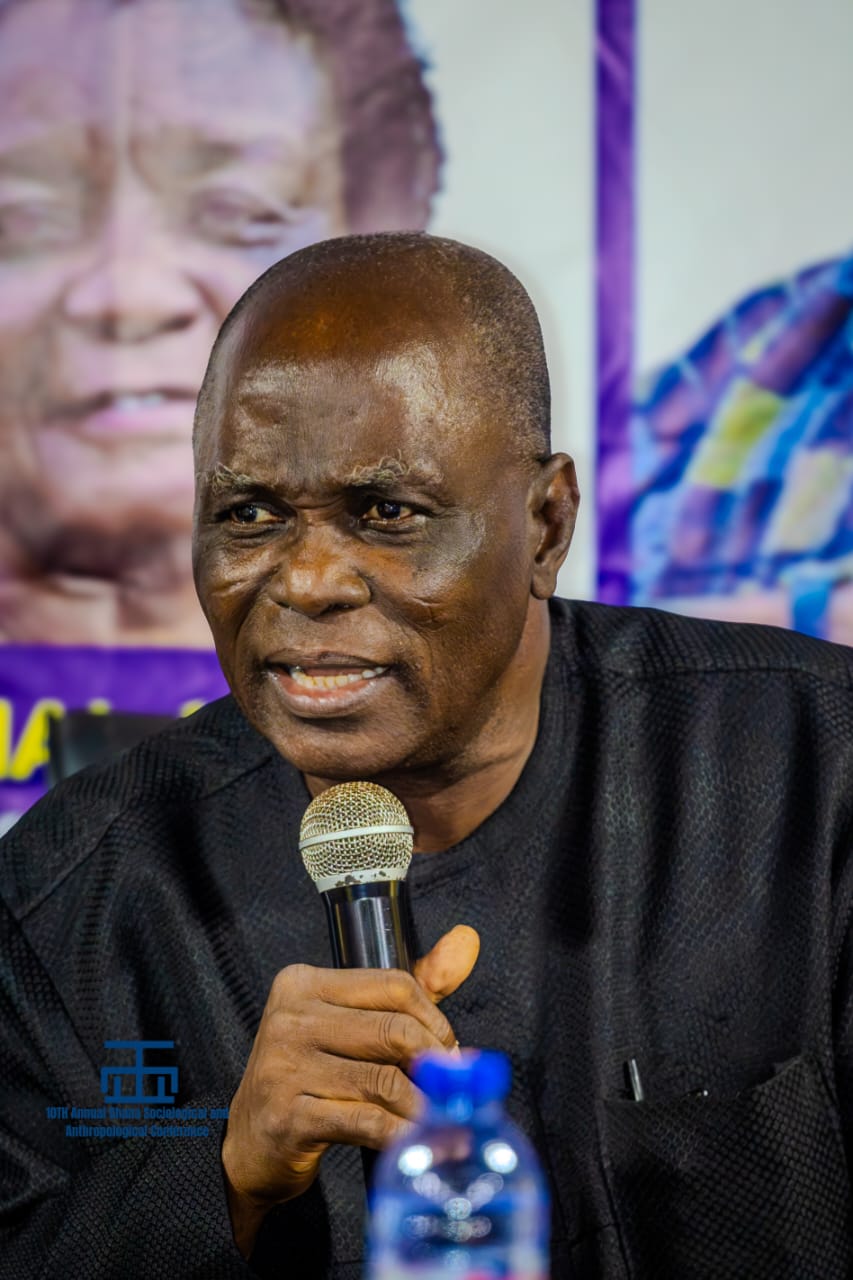
Professor Kofi Osei Akuoko, a lecturer at the Department of Sociology and Social Work at the Kwame Nkrumah University of Science and Technology (KNUST), has warned that Ghana’s public service is entering a critical period where its capacity to absorb shocks is rapidly narrowing while its responsibilities continue to expand.
Delivering an address at the 10th Annual Ghana Sociological and Anthropological Association Conference held at the University of Cape Coast, Prof. Akuoko stated that the Ghanaian public service, which serves as the backbone of healthcare, land administration, and basic education, faces severe institutional risks.
“I have chosen the word risky deliberately, and not for dramatic effect. Risk, in the Sociological sense, is not simply danger. It is exposure, a condition in which an institution’s capacity to absorb shocks has been narrowed, so that events which a stronger system would shrug off instead threaten to become crises,” he said.
He argued that the public sector’s current structural gaps stem from the historical legacy of the 1980s and 1990s structural adjustment programmes. According to him, measures such as retrenchment and wage compression hollowed out the middle layer of the public service, creating a system that is top-heavy with officers approaching retirement, bottom-heavy with young recruits, and thin in mid-level officers who transmit tacit institutional knowledge.
Prof. Akuoko highlighted the politicisation of appointments, recruitment, and advancement as a significant driver of institutional decay. He noted that every transition of political power under the Fourth Republic triggers waves of transfers, reassignments, and removals of career officers based on perceived political affiliations.
“This is not unique to Ghana, but its persistence here has a specific Sociological cost. It teaches ambitious young officers that survival and advancement depend less on competence than on cultivating the right patrons. Over a career, that lesson reshapes behaviour. Officers hedge, avoid decisions that might attract political attention, and invest energy in networks rather than in the substance of their work,” he remarked.
Referring to Max Weber’s principles of bureaucracy, he stressed that a bureaucracy’s legitimacy relies on separating the office from the office-holder. He expressed concern over the widespread practice of recruitment through informal referral and political protocol lists prior to public advertisement.
“A young graduate’s network can matter as much as a young graduate’s qualifications for that first job, and a young person with neither the connections nor an alternative route is shut out before the question of merit is even asked,” Prof. Akuoko explained.
He further cited a “quiet exit of talent” among engineers, statisticians, IT specialists, and planners who are leaving the public sector for the private domain and international organisations due to pay disparities. This, he noted, creates a negative selection spiral where the public sector is left recruiting from a narrower pool while handling complex technical tasks.
Addressing fiscal constraints linked to Ghana’s debt restructuring and IMF-supported programme, he pointed out that wage compression and recruitment freezes disproportionately affect lower and middle grades. This dynamic, combined with rigid seniority norms and slow promotion structures, risks alienating a tech-savvy youth cohort and creating a gap between expectation and reality.
On the subject of technology, Prof. Akuoko cautioned that adopting digital systems without organizational redesign simply digitises existing bottlenecks.
“A digital system designed without consulting the frontline officers who will use it, without redesigning the incentive structures around it, and without training investment to match the technology investment, tends to produce two outcomes. Either it is quietly abandoned in practice while formally reported as implemented, or it becomes a new site of exclusion,” he observed.
Prof. Akuoko also called attention to unfinished decentralisation under the Local Government Law of 1988, observing that District Assemblies still lack fiscal autonomy and technical staffing. Additionally, he noted that low public trust in core public institutions fuels an “equilibrium trap” where citizens continuously rely on informal workarounds, such as facilitation fees, which further erode formal state structures.
To reverse these trends, Prof. Akuoko recommended establishing protected middle-layer recruitment, treating digitalisation as an organizational change process, ensuring predictable fiscal transfers to District Assemblies, managing the psychological contract with public sector staff, and ensuring that future reforms account for gender disparities in public service leadership.
By: Rainbowradioonline.com/Ghana