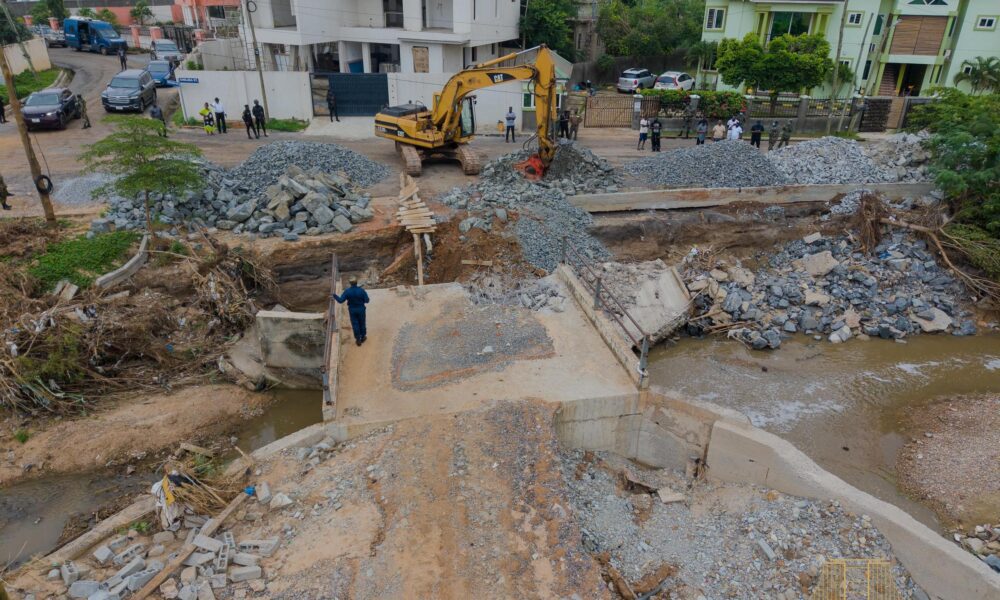
A multi-phase operation to dredge, clear silt, and tear down illegal structures across the capital has been launched by the Flood Mitigation Task Force.
Spearheaded by Stan Xoese Dogbe, Deputy Chief of Staff for Operations, and Kenneth Adjei, Minister for Works, Housing and Water Resources, alongside Works Coordinator Brigadier General Forster Okae-Yeboah, the team is actively dismantling properties blocking watercourses.
They are also pulling down substandard bridges constructed to redirect water and are dredging clogged reservoirs and drainage channels.
Joining the delegation were Major General Annan Glover, Deputy Chief of Staff at the Army Headquarters, and Brigadier General Richard Kinny, Commander of the Engineer Brigade.
The initial phase of the clearance kicked off at New England, situated behind Airport Hills and Mayfair Garden Estates, before proceeding towards the Tesa Dam in East Legon and onward to Oyarifa.
Near the Boundary Road in East Legon, the task force pulled down buildings erected directly on the banks of the Tesa Dam, where massive encroachment had severely constricted the natural course of the water.
Several private developers had erected unlawful retaining walls and unapproved structures.
Furthermore, the reckless disposal of plastic rubbish and various activities by local squatters had heavily choked the reservoir and its adjoining drains, elevating the risk of severe floods in the vicinity.
Prior to the bulldozers moving in, Lieutenant Colonel Frank Osei Amponsah, Commanding Officer of the 48 Engineer Regiment of the Ghana Armed Forces, engaged with the affected locals.
He clarified that the primary objective of the exercise was to reclaim the waterways to avert future disasters and appealed for their full cooperation.
Residents were subsequently granted time to salvage their personal effects before the structures were razed.
Speaking in an interview, Brigadier General Forster Okae-Yeboah, Coordinator of the Flood Mitigation Task Force, noted that unapproved building projects had dangerously impeded the natural movement of water. He said,
“The problem is that because people have built in this area, the channel has been narrowed. Water is therefore not able to flow freely to the holding area downstream, where it is supposed to be collected. Since the channel is blocked, the area cannot take in enough water. The water backs up, causing the surrounding communities to flood.”
He emphasised that the operation extends beyond simply tearing down structures, aiming to keep the reclaimed channels permanently free from trespassers.
“After the demolition, we are going to clear the debris, dredge the area, and create a buffer zone where people will no longer be allowed to build. We will also ask the assemblies to monitor the area so that whenever anyone attempts to encroach on it, immediate action is taken,” he added.
Adding his voice to the development, Kenneth Gilbert Adjei, the Minister for Works, Housing and Water Resources, disclosed that the clearing of drains nationwide will now be a permanent initiative, following explicit instructions from President John Mahama.
He said, “The President has directed that this should be an ongoing exercise. So, you are not just seeing us here today and that will be the end of it.
After the demolitions, we will continue dredging throughout the year so that whenever it rains, the water will have enough space to collect. It will be a year-round exercise. The President has directed that we ensure the kind of flooding we recently experienced is not repeated in our communities.”
The task force remains determined to unblock and revitalise all identified watercourses, reservoirs, and drainage systems across these initial three sites.
Once completed, the second phase of the operation will shift focus to addressing similar drainage crises in Weija, Mallam, and the Laboma enclave.
By: Rainbowradioonline.com/Ghana