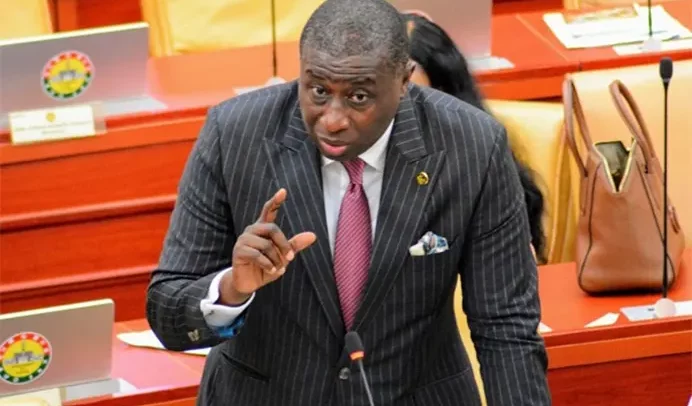
The New Patriotic Party (NPP) can organise its parliamentary primaries using the old delegates system if it adheres strictly to its planned timetable before the Supreme Court’s decision takes full effect, the Member of Parliament for Okaikwei Central, Patrick Yaw Boamah, has stated.
The lawmaker emphasised the urgent need for the ruling party to immediately constitute a dedicated committee to oversee necessary constitutional amendments to align party rules with the judicial directive.
The apex court recently scrapped the traditional delegates system, directing political parties to allow all registered members in good standing to vote in presidential and parliamentary primaries, with a one-year window granted for full compliance.
Sharing his perspective on the ruling during an interview on Frontline with host Kwabena Agyapong, Mr Boamah explained that the NPP’s current internal electoral calendar works in its favour if executed efficiently.
“The Supreme Court has granted us a year to put our house in order. Thankfully, the NPP has conducted its presidential primary and elected its flagbearer. We are currently preparing to elect our regional and national executive officers by August and September. If we are able to go according to plan, the NPP can even organise its parliamentary primaries within a period before the decision of the court takes effect.
“So we have to do all these things so that we can reform our constitution to be in line with the decision of the court. It will come with some regulations or modalities because issues of who is a registered member, who is a member in good standing, at what point the party can refer to someone as being a member in good standing and qualified to vote; those are modalities the party ought to work on,” he noted.
Detailing the roadmap for internal reforms, the legal practitioner advised the party hierarchy to launch a committee tasked with gathering input across all structures of the organisation—from the grass roots through to constituency, regional, and national levels—prior to submitting recommendations to the national delegates conference.
“So we have a long way to go. We have a constitutional amendment to deal with. We have a constitutional and legal committee of the party and the electoral affairs committee to look at some of these issues and advise the party,” he said.
Mr Boamah stressed that directives issued by the highest court in the land are binding and non-negotiable for all citizens and institutions.
Speaking on the legal obligation, he remarked: “If the highest court of the land issues directives or orders, who are you as a practitioner to say otherwise? We respect the orders of the court.”
“It calls for the political parties to embark on major constitutional amendments to their respective constitutions so they will be able to implement the decision of the Supreme Court,” he added.
Addressing concerns over the financial burden the sweeping changes might impose on political parties, the lawmaker acknowledged that democratic processes inherently require significant resources. However, he urged the NPP to craft pragmatic guidelines to keep expenditure manageable.
“Democracy is very expensive. Every reform, action, or activity embarked on by any political party comes at a cost. But as a party, we must do as much as possible to ensure that our modalities and arrangements don’t cost much to stakeholders in order to elect candidates who have what it takes and are the best people to lead the party in the constituencies as parliamentary candidates and also as our presidential candidate,” he stated.
Crucially, Mr Boamah cautioned political parties to institute robust safeguards to avert dual-membership abuses, ensuring individuals are blocked from registering simultaneously across opposing political camps.
By: Rainbowradioonline.com/Ghana