Policy analyst Bright Simons has cast serious doubt on the celebrated financial turnaround of Ghana’s state-owned enterprises, accusing the State Interests and Governance Authority (SIGA) of publishing data laden with bizarre errors, misstatements, and flawed inferences.
Following SIGA’s announcement that state-controlled businesses recorded incredible profits in 2025 after years of persistent losses, analysts took the report to task using data tools like Tabula and Excel Power Query. According to Mr Simons, the claim of a massive turnaround simply does not hold up when subjected to rigorous scrutiny.
He noted that the report, as currently presented, fails to paint an accurate picture of affairs at state-controlled businesses, particularly when read against previous reports issued by the regulator.
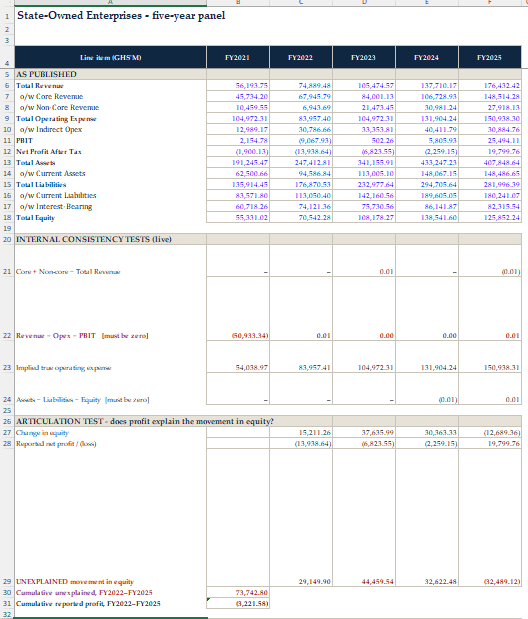
Highlighting severe inconsistencies in historical figures, Mr Simons pointed out that the net loss for 2023 was published in three different ways across successive reports: GHS 2,573.2 million in the 2023 report, GHS 7,143.5 million in the 2024 report, and GHS 6,823.55 million in the 2025 report. Similarly, the net loss for 2022 has been published in four different ways, while revenue for 2021 appeared in five different versions.
“Total liabilities for 2021 appear as GHS 135,883 million in the 2021 report, GHS 172,043 million in the 2023 report, and GHS 135,914 million in the 2025 report, a GHS 36 billion excursion that appears and then vanishes,” he stated, adding that such confusions make standard cross-year comparisons almost impossible.
When underlying data is adjusted for currency fluctuations, Mr Simons revealed that state-owned businesses actually experienced a decline in underlying profitability in 2025.
“Contrary to what SIGA says, when you remove the currency effects, net profit fell 17.1 per cent, operating profit fell 22.7 per cent, and the operating margin narrowed by three and a half percentage points between 2024 and 2025,” he explained.
He attributed the vast majority of the reported profit swing to foreign exchange fluctuations at the Electricity Company of Ghana (ECG). ECG moved from exchange rate losses of GHS 8,837.71 million in 2024 to an exchange gain of GHS 12,157.79 million in 2025. That single swing of GHS 20,995.50 million accounts for 95.2 per cent of the entire GHS 22,058.91 million profit swing celebrated by SIGA.
Stripping away exchange rate revaluations, ECG’s operating result collapsed from a profit of GHS 1.84 billion to a loss of GHS 14.25 billion. Its operating cash flow similarly swung from an inflow of GHS 6.51 billion to an outflow of GHS 12.54 billion, forcing the company to take in GHS 20.44 billion in new financing just to stay afloat.
The analyst further questioned the logic of celebrating profits when actual returns to the state remain minimal. Across 53 fully state-owned enterprises, only 1.4 million US dollars in dividends were realised in 2025, representing a 45.5 per cent drop in dividend tally compared to 2024.
“Celebrating ‘profits’ when dividends are crashing?” he asked, noting that the reported 976 per cent improvement from 2024 to 2025 is mathematically meaningless because percentage increments cannot be applied when swinging from a negative value to a positive one.
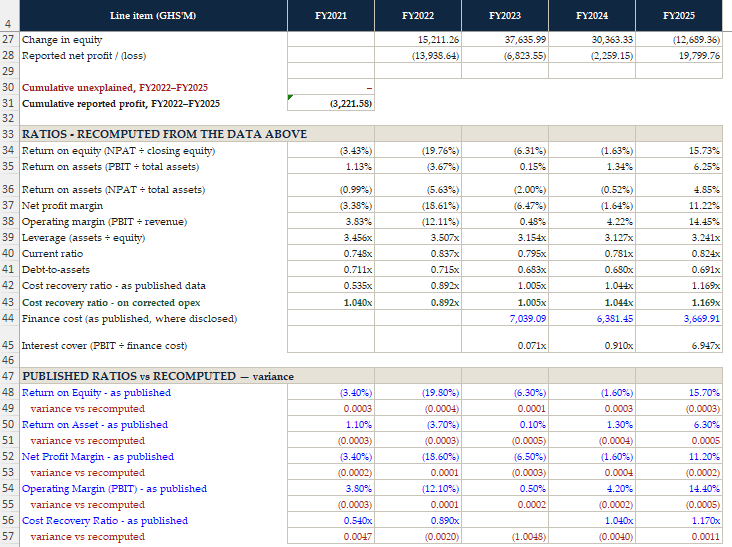
Mr Simons also exposed what he termed a GHS 50.9 billion mistake in SIGA’s published cost figure for 2021, where GHS 104.97 billion was used instead of GHS 54.04 billion—a duplicated figure carried over from 2023. This error falsely created the illusion of dramatic efficiency gains as cost-covering ratios appeared to climb from 0.54 to 1.17, whereas the corrected 2021 base was already 1.04. He revealed that this duplication pattern appears across all five SIGA reports from 2021 to 2025, affecting various chapters including mining and joint ventures.
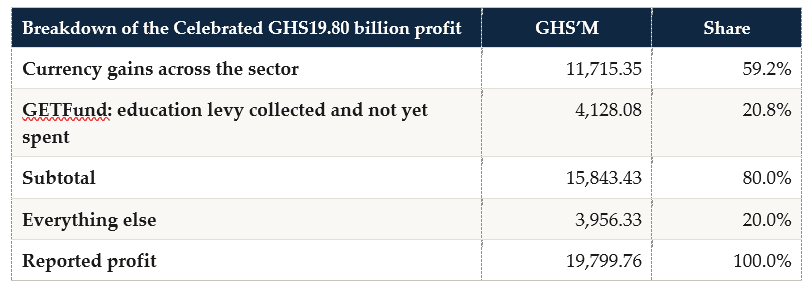
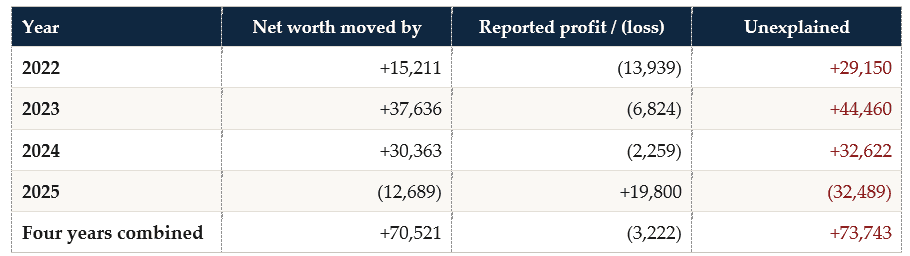
Additional anomalies cited include an unexplained GHS 12.69 billion drop in equity in 2025—creating a GHS 32.49 billion gap from the profit line—and the disappearance of GHS 7.42 billion in 2024 losses between the 2024 and 2025 report editions with zero disclosure. Furthermore, SIGA booked GHS 4,128.08 million in unspent GETFund levy allocations as enterprise profit and inappropriately attributed total profits from entities where the state holds negligible shares, such as a 0.04 per cent stake in AngloGold.
Given the depth of these discrepancies, Mr Simons called for immediate corrective action, insisting that SIGA should withdraw all its reports from 2020 to date, rectify the errors, and submit a reliable financial series to the public.
Read below his analysis
- We were all there when SIGA, an agency that regulates state-owned or controlled businesses and parastatals, came and told us that state-controlled businesses have made incredible profits in 2025.
- This was presented as a massive turnaround after years of losses.
- Someone seemed to have forgotten that Ghana still has nerdy policy analysts who spend their lunch time poring over figures.
- With the help of Tabula and Excel Power Query, we have taken the SIGA report to task.
- Unfortunately, it simply doesn’t hold up.
- In fact, some of the findings are pretty bizarre.
- The report as currently presented does not paint an accurate picture of affairs at state-controlled businesses in Ghana. It is replete with bizarre errors, misstatements, confusions, and flawed inferences. Especially when read against previous SIGA reports.
- For example, the net loss for 2023 has been published in 3 different ways: GHS 2,573.2 million in the 2023 report, GHS 7,143.5 million in the 2024 report, and GHS 6,823.55 million in the 2025 report.
- The net loss for 2022 has been published in 4 different ways. Revenue for 2021 has been published in 5 different five ways.
- Total liabilities for 2021 appear as GHS135,883 million in the 2021 report, GHS172,043 million in the 2023 report, and GHS135,914 million in the 2025 report, a GHS36 billion excursion that appears and then vanishes.
- These confusions make it really hard to make the comparisons across years that SIGA is trying to push us to do.
- But when we do, we are forced to different, highly unflattering, conclusions. As follows.
- State-owned businesses’ underlying profitability declined in 2025. You heard that right. Contrary to what SIGA says, when you remove the currency effects (which as analyst @CallmeAlfredo stresses must be done for safe comparisons), net profit fell 17.1 per cent, operating profit fell 22.7 per cent, and the operating margin narrowed by three and a half percentage points between 2024 and 2025.
- Basically, ECG went from exchange rate losses of GHS 8,837.71 million in 2024 to a gain of GHS 12,157.79 million in 2025. That swing: GHS20,995.50 million, is 95.2 per cent of the entire profit swing of GHS22,058.91 million that SIGA is celebrating.
- Take exchange rate revaluations out and ECG’s operating result goes from a profit of GHS1.84 billion to a loss of GHS14.25 billion. Its operating cash flow moved from an inflow of GHS6.51 billion to an outflow of GHS12.54 billion, a swing of GHS19.05 billion in the wrong direction, while the company took in GHS20.44 billion of new financing to stay afloat.
- Only $1.4 million in dividends were realised from the 53 fully state-owned enterprises in 2025. The dividend tally actually fell by 45.5% in 2025, compared to 2024. Celebrating “profits” when dividends are crashing?
- Moreover, the celebrated turnaround is being measured against a baseline that was reduced by three-quarters between editions, using a ratio whose definition changed at the same time. Neither adjustment was disclosed.
- In simple terms: SIGA told us that a loss of GHS 2.26 billion in 2024 switched into a profit of GHS19.80 billion in 2025. But as everyone now knows, if you ignore the currency revaluations, profit actually fell from GHS9.75 billion to GHS8.08 billion, a decline of 17.1 per cent.
- (By the way, the “976%” improvement from 2024 to 2025 that has been reported is totally meaningless. One can’t use a percentage incremental when swinging from below zero – negative – to positive).
- SIGA’s published cost figure for 2021 is wrong by GHS 50.9 billion. Instead of GHS 54.04 billion, GHS 104.97 billion is used. The wrong number is replicated from the 2023 figure. This crazy error is presented as evidence that State companies are becoming more efficient at covering their costs. The published series thus climbs from 0.54 in 2021 to 1.17 in 2025 to underline the success story. If corrected, 2021 was already 1.04. Most of the “improvement” is from a pure mistake.
- (The craziest thing is that this is not a one-off. In all five SIGA reports from 2021 to 2025, the earliest year’s cost figure is an exact copy of the figure two years later in the same table. And it is not confined to that table: the 2025 report duplicates cells in its mining chapter and its joint-venture chapter too, at different intervals. These are not typos. Something messed up seems to be going on.)
- The other strange thing is how SIGA fails to explain how equity dropped by a whopping GHS 12.69 billion in 2025 creating an inexplicable GHS 32.49 billion gap from the profit line. Even as net worth has been reported as rising for the three previous years of losses. So somehow the net worth of the businesses that has been rising during the years of losses suddenly drops when humongous profits show up?
- Another bizarre issue is that the 2024 report says State businesses lost GHS 9,675.43 million that year and reported a return on equity of minus 8.5 per cent. The 2025 report says the loss in 2024 was GHS 2,259.15 million. GHS 7.42 billion of losses disappeared like smoke. With zero explanation.
- Apart from the currency revaluations, SIGA also booked GHS 4,128.08 million as profits from GETFund. That money is simply the portion of the levy (a kind of tax) Ghanaians pay that GETFund hadn’t got around to spending yet by the end of the year (more likely, it wasn’t released to them.)
- As for the entities in which Ghana owns a tiny stake (like 0.04% in Anglogold), it is comical how their total profits were reported as if they can be attributed to Ghana.
In short, SIGA should withdraw, not just the confusing the 2025 one, but all its reports from 2020, fix the errors, and submit a more reliable series.
By: Rainbowradioonline.com/Ghana